Daycrate · AI engineering · Solo developer
A planning assistant that works with your day.
I built AI planning, natural-language capture, and a tool-using assistant into Daycrate, connecting the model to tasks, notes, reviews, and decisions already in the product.
Visit Daycrate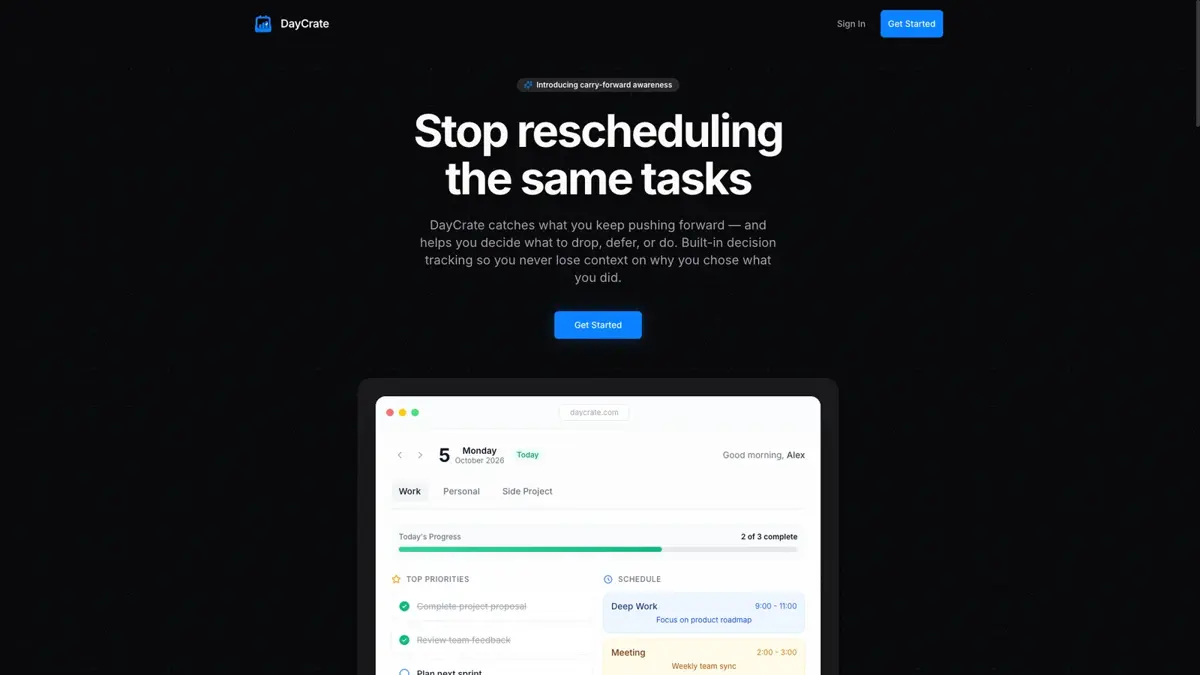
The problem
Planning requires more than a list of tasks. Priorities, unfinished work, available time, and earlier decisions all affect what belongs in a day. The engineering challenge was to bring that context into an assistant while keeping its proposed changes inspectable.
What I built
Ground answers in personal context
Hybrid retrieval combines pgvector similarity with full-text search using reciprocal rank fusion. Queries are scoped to the user, and answers link back to the records used as sources.
Keep changes reviewable
The chat agent reads context through tools and proposes structured changes. Users apply suggestions through the app’s existing services, preserving ownership checks and plan limits. Zod validates model output and stored suggestion payloads.
Build for the product around the model
A Next.js interface connects to a NestJS backend through the Vercel AI SDK. BullMQ keeps memory in sync as records change. Usage metering, per-feature configuration, and opt-out cleanup are part of the implementation.
Connect external assistants
An MCP server exposes task, day, priority, habit, project, and report tools. Each server instance binds its tools to the authenticated user’s context.
Recorded evaluation · September 26, 2026
10 of 10 planning cases passed.
The saved planning evaluation ran the real planner against DeepSeek with Jev ranking enabled. Checks cover valid backlog references, priority capacity, and time blocks that respect scheduling constraints. The harness also supports natural-language capture evaluation.
This was one run of a 10-case planning set, with database, user context, credits, and suggestion storage stubbed. It is a bounded regression result, not a production accuracy or user-impact measurement.
The tradeoffs
Hybrid retrieval gives the assistant both semantic matches and exact-text signals, at the cost of maintaining an embedding pipeline. Structured suggestions add a review step, but let the application validate and apply changes through familiar business rules. A deterministic evaluation harness makes prompt changes testable; broader cases and repeated runs are still needed to measure reliability across more situations.